
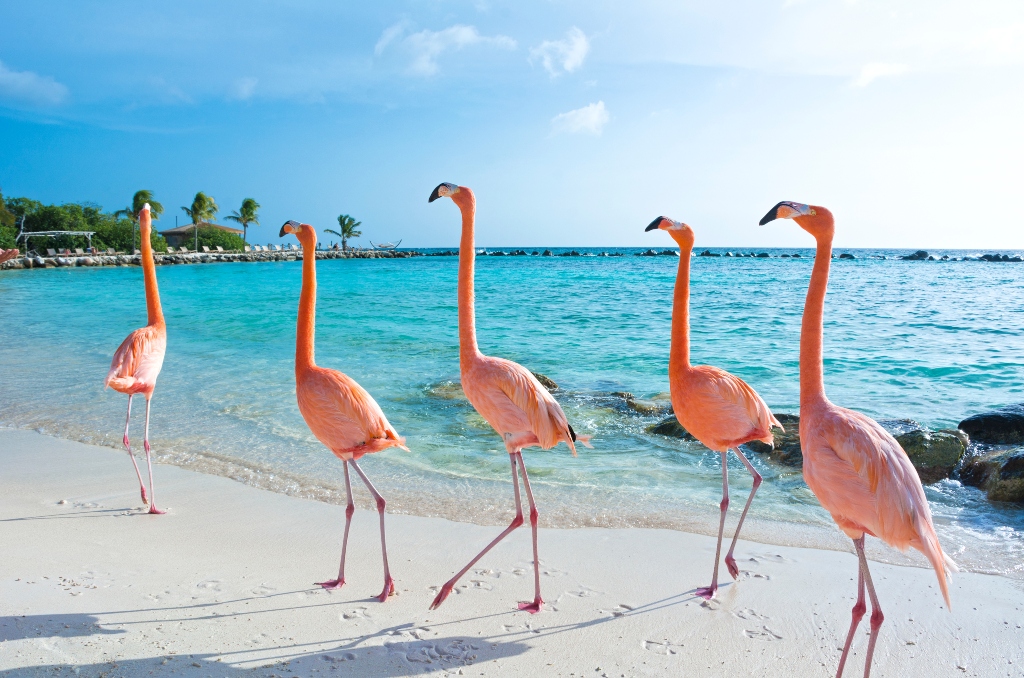
Pink Flamingos – Courtesy: Shutterstock – Image by Natalia Barsukova
In August 2023, a flock of 300–400 flamingos, probably migrating between the Yucatan Peninsula and Cuba, was blown off course by Hurricane Idalia. The birds were then unceremoniously deposited across a large area of the eastern United States, from the Gulf Coast of Florida to Wisconsin and east to Pennsylvania.
I work as an estuary scientist. In other words, I research habitats where freshwater enters the ocean. I have been researching the ecology of American flamingos and other wading birds in Florida Bay, Everglades National Park, for 35 years with Audubon Florida. Naturally, I was excited and fascinated by these flamingos’ unexpected appearance.
After almost drowning in the Gulf of Mexico, one of the birds was saved in the Tampa region. Peaches is the name his rescuers gave him.
Together with a coworker, I managed to secure a GPS tracking device and a vivid blue band bearing the code “US02” in white letters around his slender leg.
We wanted to monitor his whereabouts and find out if he settled in Florida. Regretfully, the tracking gadget malfunctioned a few days after Peaches was returned to the wilds of Tampa Bay. On October 5, 2023, he was last seen on a beach close to Marco Island.
I then got an email in June 2025 from colleagues at the Rio Lagartos Biosphere Reserve in Yucatan, Mexico, who had taken pictures of peaches nesting there with their blue bands still in place.
The most recent addition to Florida’s flamingo history is Peaches’ tale. Even though the native population vanished over a century ago, recent occurrences have convinced me that flamingos might be returning to the Sunshine State, and that the restoration of the Everglades and coastal habitats has made this possible.
A population’s decision
“The Flamingos: Their Life History and Survival,” written in 1956 by ornithologist Robert Porter Allen, creator of the National Audubon’s Everglades Science Center, is still regarded as a landmark work on the history of flamingos in Florida.
Allen references a number of nineteenth-century historical and scientific documents in his book that show hundreds to thousands of flamboyances were observed in the Florida Keys, Florida Bay, and the Everglades.
Allen chronicles the decline of flamingos in Florida and across their range in the Caribbean and the Bahamas in the late nineteenth century. They succumbed to the women’s fashion trend of decorating hats with bird feathers, just like all other wading birds in Florida. In actuality, wading bird feathers were worth their weight in gold.
The ensuing grassroots environmental effort, spearheaded by the National Association of Audubon Societies’ outspoken resistance, resulted in legislation that outlawed the killing and sale of bird feathers. However, it was challenging to police those restrictions amid Florida’s small population, and deputized Audubon wardens were killed twice while defending wading bird nesting colonies.
Thankfully, social pressure changed the tide against the feather-wearing custom in a matter of years. The feather trade came to an official stop in 1918 with the passing of the Migratory Bird Treaty Act.
By the 1930s and 1940s, most species—possibly migrating from isolated populations in Central America and the Caribbean—had successfully reestablished sizable nesting populations in the Everglades thanks to legal protection.
But the flamingos didn’t.
A protracted recuperation process
Allen estimated flamingo populations were only about 25% of what they had been in the previous century in 1956, 40 years after hunting had stopped. The numbers had fallen from 168,000 to 43,000 breeding adults. They only nested in large numbers at four sites, as opposed to 29 in the past.
Flamingos may have a hard time recovering because of their unusual breeding habits and long lifespan (they can live up to 50 years in the wild). Other Florida wading birds can lay three to five eggs at a time in nests they set up at various locations throughout the year.
In contrast, flamingos lay only one egg and nest only once a year, usually returning to the same spot year after year. Furthermore, partly because of their complex group courtship behaviors, they prefer to build large nesting colonies with thousands of nests.
Cause for optimism
Due to their scarcity during the 1950s and 1980s, scientists, including myself, thought that any flamingos that were occasionally seen in the Florida area were actually escapees from captive groups rather than wild birds.
14 birds were seen in Biscayne Bay in 1934, the day after Hialeah Race Track in Miami brought in a group of roughly 30 flamingos, making it the largest flock seen in the state between 1930 and 1976. The birds just flew away when they were released since the track’s owners had neglected to pinion them.
However, when a flamingo dressed as a chick at Rio Lagartos was shot in Florida Bay in 2002, my perspective started to shift. Another Rio Lagartos bird was photographed in 2012.
By then, I had seen flamingos in Florida Bay on multiple occasions, including 24 and 64-person flamboyances. The banded birds gave me some indication that at least some wild flamingos were beginning to spend time in Florida, but I still believed that most of these flocks were escapees.
In 2015, my colleagues captured a flamingo at the Key West Naval Air Station and equipped it with a tracking device. In December 2015, Conchy, as we called him, was discharged in Florida Bay with the blue band US01.
He spent two years in Florida Bay, and I saw his length of stay as evidence that flamingos may establish a more permanent home in Florida.
Together with a few collaborators, I released a paper in 2018 that presented historical narratives and previously unrecognized museum evidence indicating flamingos were native to Florida. Additionally, we provided fresh data from citizen science sites and researchers that clearly showed Florida’s wild flamingo population was growing. This implied that the population might be on the verge of recovery.
Call it a resurgence.
Today, it seems that this gradual resurgence might finally be gaining traction. My Audubon Florida colleagues and I performed a weeklong online survey of flamingo sightings in Florida six months after Hurricane Idalia.
Over fifty credible observations were sent to us. We determined that there were still at least 100 flamingos in the state after sifting through these data to eliminate duplicates.
Then, a group of 125 birds was captured on camera in Florida Bay in July 2025. My coworkers and I think that the flamingos who came with Idalia might be reestablishing a home in Florida based on our findings.
Restoration progress
Why now, one could ask? Neither the twenty-four flamingos I saw in 1992 nor the sixty-four I saw in 2004 established permanent residence in the state. What has changed, then?
The answer is obvious to me: There is some progress being made in restoring Florida’s coastal habitats and the Everglades.
An ecological collapse was occurring in Florida Bay when I arrived in the Keys in 1989. According to a federal government interagency assessment from 1993, the water’s salt content had increased due to a century of draining, diking, and rerouting the Everglades’ flows to make way for urban and agricultural areas, rendering it inhospitable for many estuary creatures.
According to the report, there was a significant die-off occurring in the bay’s well-known seagrass beds, along with algal blooms that reduced oxygen levels and killed a lot of fish. On its several islands, mangrove trees were dying, and birds that had nested there for decades had vanished.
Everglades restoration efforts were sparked by these occurrences, and the Comprehensive Everglades Restoration Plan was passed by the U.S. Congress in 2000 with almost universal bipartisan support. It was to be the biggest and most costly ecological restoration project in history, with a price tag in the tens of billions of dollars.
The bay is much healthier now than it was when I visited in the 1980s. The water flow has improved, and the salinity has returned to levels suitable for wildlife.
Over 100,000 pairs of wading birds, including roseate spoonbills, wood storks, and white ibis, nested in the Everglades between 2018 and 2021. Since the 1940s, these figures had not been observed. 20,000 nesting pairs was considered a banner year in the 1980s and 1990s.
The reintroduction of flamingos like Conchy and Peaches, in my opinion, is proof that these efforts are headed in the right direction, even though the Everglades and Florida Bay are still a long way from complete restoration.
Make sure you are staying up-to-date with the latest and most important Florida news with Florida Insider. Whether you are interested in business, education, government, history, sports, real estate, nature, weather, or travel: we have something for everyone. Follow along for the best stories in the Sunshine State.

Born and raised in South Florida, Krystal is a recent graduate from the University of Miami with professional writing experience at the collegiate and national news outlet levels. She’s a foodie who loves all things travel, the beach, & visiting new places throughout Florida.