
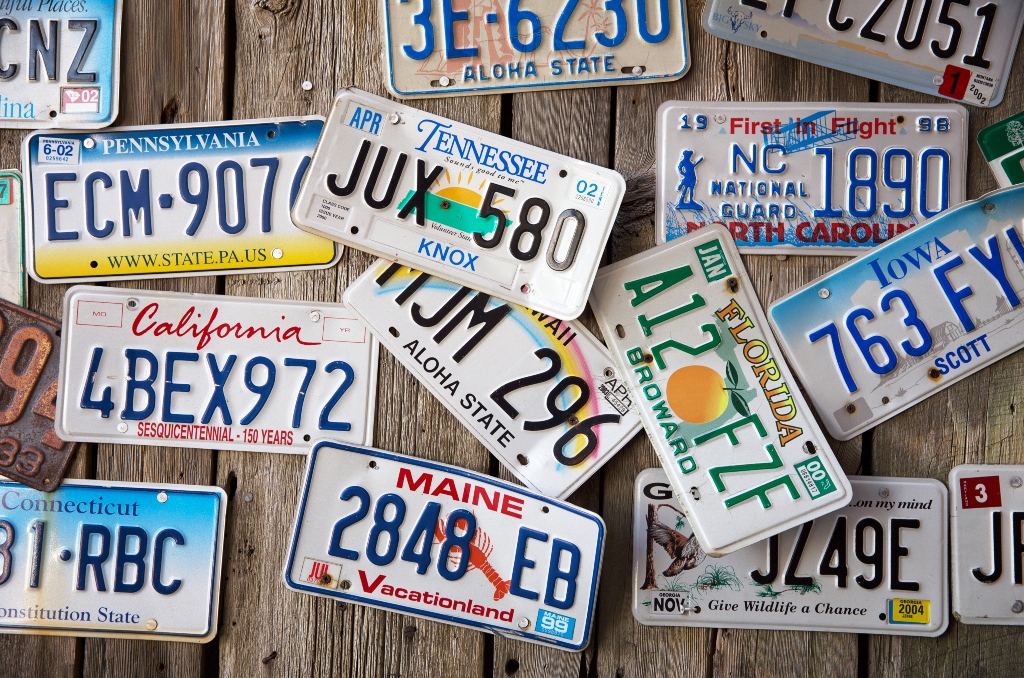
License Plates – Courtesy: Shutterstock – Image by Jane Rix
Orlando, Florida – Is the frame on your license plate illegal? Following the implementation of a new legislation on October 1, that is the question that Florida drivers and law enforcement officials have been posing.
As previously reported by News 6, there was so much confusion that the state had to provide an explanation last week.
According to Florida Statute 320.262, anyone who obscures or obstructs the view of a license plate’s main features—namely, the license plate number and the validation sticker in the upper right corner—faces a second-degree misdemeanor punishment.
However, enforcement and interpretation of the law differ greatly throughout the state, notwithstanding its objective.
Drivers have been warned by some organizations, such as the Ocoee Police Department, that “a traffic stop and a citation may result if a frame or cover conceals even a small section.” A similar caution has been issued by the Southwest Florida State Attorney’s Office.
In the meantime, a lengthy online statement from the Volusia County Sheriff’s Office declared that “there is no violation as long as the alphanumerics and decal are visible and legible.”
However, in the weeks after the statute went into effect, News 6 discovered that over a dozen citations had been issued throughout Central Florida. This ornamental palm tree frame was one of several drivers in Fruitland Park who were given citations for frames that only partially covered their license plates.
The main concern, according to Rachel Mattie, a criminal defense lawyer with the Umansky Law Firm, is preventing the recording of plate information.
The problem with this new law is that it doesn’t really change much in terms of what is and isn’t permitted; the main distinction is that it will now be punished differently. Thus, it is now a criminal violation rather than a traffic infraction,” Mattie stated.
The phrase “a person may not alter the original appearance of a license plate, whether by mutilation, alteration, defacement, or change of color or in any other manner” is what Mattie considers to be “vague” in the new law.
According to the law, you are not allowed to change your license plate’s original look in any way. Thus, this might possibly be the border, Mattie remarked.
Mattie advises against “avoiding the license plate frames altogether, not putting yourself in that position” due to the possibility of criminal accusations. However, if you are pulled over, the fight will take place in court with a lawyer, not by the side of the road with an officer.
According to Steven Montiero, a traffic safety expert on News 6, drivers must be aware of the possibility of getting pulled over.
According to the legislation at the moment, Montiero stated, “anything that obstructs that tag can get you pulled over.”
Although Montiero pointed out that the statute affords authorities the right to halt automobiles for minor plate obstructions, they might not be deliberately seeking to do so.
“I would advise everyone to be safe right now. As long as your tag frame does not cover any text, such as the words Florida at the top or Sunshine State or your county at the bottom, then you are good to go,” he said.
The Florida Department of Highway Safety and Motor Vehicles sent a letter to law enforcement agencies on December 12 to help explain the statute.
Executive Director Dave Kerner stated that license plate frames are permitted as long as they don’t obscure the plate:
The decal situated in the upper right-hand corner of the plate; and the alphanumeric characters.
Any information at the bottom of the plate, such the county name or state website, is not regarded as a “primary feature,” the department explained. Therefore, as long as the plate’s essential distinguishing features remain visible, a frame that covers that portion might still be acceptable.
The memo also cited a 2019 decision from the Fourth District Court of Appeal in Florida, which examined a comparable statute (s. 320.061 F.S.). In that instance, a license plate frame was deemed acceptable since it did not obstruct any identifying information, despite the fact that it partially obscured the plate’s bottom.
If law enforcement officials require additional advice, they are still advised to speak with their agency counsel.
Make sure you are staying up-to-date with the latest and most important Florida news with Florida Insider. Whether you are interested in business, education, government, history, sports, real estate, nature, weather, or travel: we have something for everyone. Follow along for the best stories in the Sunshine State.

Chris began his writing as a hobby while attending Florida Southern College in Lakeland, Florida. Today he and his wife live in the Orlando area with their three children and dog.
